Posts

Showing posts with the label articles

Sultan Suleiman Era, Turkish Miniatures 2

Image
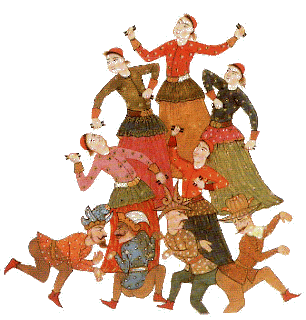
In the East, during war and later peace with Iran, lead to continuous relations and has been one of the essential sources for influence and inspiration for Ottoman painters. Numerous eastern works and books were duplicated, reprinted, translated and illustrated. The accounting books of the time (Ehl-i Hiref books) show Iranians were the majority among palace artists. The miniature of Firdawsi of Bursa in his Suleimanname is a good example of the period. Sultan Suleiman (The Magnificent) period is an important mark in the history of miniature. Regular recording of important historical events, wars, campaigns, celebrations, innovations, in and out going ambassadors etc started, and illustration of such books became customary. The palace officially started to employ writers and artists, and profession of sehname writing emerged. We can count Hamse of Nevai (TPM, H. 802), Divan of Nevai (TPM, R. 804), Tuhfet-el Ahrar among (TPM, R. 914) the most significant of these works. But, perhap...

Pictures and Painting in Islam

Image
It is only time that we touch a few thorny subjects, and possibly the thorniest of them all is the status of pictures or painting in Islam and Islamic art. The so called ban on pictures opens the door to a myriad of conflicting views and the end result is more than one billion confused people. Some Islamic scholars claim it is banned in any and every form, some claim the ban is on animate objects, some say it is only limited to picturing the prophet, i.e. Mohammad, and some of course believe there is no such restriction at all. The issue has not come to the attention of the West until Taliban's destruction of an ancient Buddha temple (because it has a picture of Buddha) in Afghanistan in March 2001. After the temple were blown to pieces, the idea that Islam is hostile to painting has emerged in the West, and exacerbated with the Mohammad caricatures or cartoons of last year. Before we proceed, let us also define what we mean by Islamic art. Sheila S. Brown and Jonathan M. Bloom giv...

A Primer on Turkish Miniatures

Image
Western languages define miniature as a small sized sample of an object. Later, the word has acquired an additional meaning for drawings or pictures of a book. Old Turkish (I am using it very loosely, please do not forget nationalism is a concept of 18th century and onwards; obvious, but often forgotten by many) sources use the words nakis or tasvir for miniature, while the artist is called nakkas or musavvar (let me also note none of them is actually Turkish; they are Arabic). We find wall paintings and pictures of various figures alongside miniatures among examples of Turkish painting in the Uighur centers of Hoco, Bezeklik, Sorcug in Turfan region dating back to 8th and 9th century. The main theme of the miniatures before the Islamization of Turkish tribes is Uighur princes or princesses and Mani priests. However, many belief systems intersected in the region and rich and diverse (subject matter) miniatures were found. Later works until 13th century were unfortunately lost (it is ...

How to (correctly) Interpret Ottoman Calligraphy

Ottoman calligraphy is a thorny subject. Just like the era of the artists, we observe the scene is now dominated by religious figures on a scale of absurdity to zealotry. According to these, the artists had one and only one thing in their minds: to promote the prophet; they were overflowing with love of god, so they had to write the same words time after time. I am not an artist, but I happen to know a few, and I am not obsessed with religion. So I hold a different and radical view on these works of art. As I briefly touched in Hilye-i Serif, the Artist's Battle Cry , they were creative people who had to operate within clearly defined and enforced constraints. Their tools were words that glorified the prophet, their colors the prophet's virtues. If you think they entertained themselves with a sadistic pleasure by inscribing the same words and virtues over and over again, be my guest, or rather their guest who think this way. On the contrary, they were free spirits who enjoyed ...

Hilye-i Serif, the Artist's Battle Cry

Man has an intrinsic compass pointing towards beauty and aesthetics. It chooses one form over another, prefers a particular style, ratio, color and shape among many. But above all, it urges him/her to copy, reproduce and eventually create. From birth, humans accumulate all sorts of input surrounding themselves, and one day, just like a volcano, it erupts. Some of this lava is more appealing than others to many, and it is called art . For centuries, Muslim artists had suffered from an interpretation of Koran that claimed drawing of human body was a sin (Sadly, it is still true for some parts of the world). Yet, the urge to create, to express themselves was so great that they looked for ways to channel their creativity while satisfying the clerics who defended this bigotry vigorously. But there is a crack, a crack in everything, that's where the light comes in. And they found their crack: hilye-i serif. Only in this case, the light went out, not in. Hilye-i serif is a form of art, a ...

What is Tombac

Most dictionaries including wikipedia simply define tombac as an alloy of copper and zinc (85-90% and 10-15% respectively). However, tombac-ing, if I may use it as a verb, is a technique of casing or plating with gold. Copper and copper alloys are veneered with an amalgam of gold and mercury, and tombac is the common name for pieces plated with gold using this technique. It is a delicate process requiring patience and perfect timing. After preparing the gold and mercury amalgam, the piece is cleaned with sulphuric acid. Then it is brushed with mercury diluted in water. Now comes the amalgam which is again brushed over the piece and heated until mercury evaporates. The result is a thick and extremely durable gold plating. Topkapi Museum hosts a variety of products, trays, bowls, pitchers, torches, candlesticks, chandeliers, etc made of tombac.