Posts

Showing posts with the label calligraphy

Ferman of Sultan Mahmud I

Image
Dated 1732, this ferman of Sultan Mahmud I can be considered one of the outstanding examples of Ottoman calligraphy. Considering it was written only for the ordinary task of transfer of tax collection rights to Esseyyid İbrahim upon Eyüb Sabri's death (none of them had any historical significance), the amount of work put in it is remarkable, it is like getting your tax return with a document like this. Written in ruby, gold and black ink in celi divani style, enameled with gold flowers, it really shines. Dimensions: 128.5x52.5 cm. Estimated value: $45,000
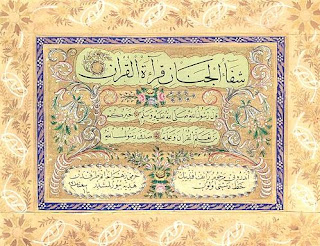
Board by Raif Efendi

Image
I liked the colors of this board by Raif Efendi (Enderunlu). True, it is not one of the finest examples of calligraphy nor the most expensive one. Yet, it has a subtle beauty that captures my attention. I do not know why. Dated: 1915 Dimensions: 28x34.5 cm Estimated value: $ 350

Ruba'i Board by Mehmed Esad Yesari

Image
Ruba'i is the Persian quatrain made especially popular by Omar Khayyam. Since 11th century its popularity has never ceased in Asia Minor. Calligraphers loved them. Just like its Japanese counterpart haiku (which is three lines), its shortness and directness made it an obvious choice for artists who were somewhat restricted by religious dogma. Mehmed Esad Yesari's rubai board is dated 1791 and a good example. Dimensions: 33.5x20 cm. Estimated value: $ 1,500

Kita Board by Mustafa Vasif

Image
I planned to finish a series of articles because of Thanks Giving but when I saw this kita board by Mustafa Vasif among the files, I decided to post it right away. Dated 1791, it is one the finest examples, I think. Dimensions: 15x22 cm. Estimated value: $ 7,500

Rococo Board by Ismail Hakki Mektubi

Image
Another fine example of Ottoman calligraphy, a signed (with ketebe) board by Ismail Hakki Mektubi (?-?). It praises all the sultans of the empire, starting from Osman (Othman), the founder, to Abdulaziz. Written with a talik style, the board is ornamented with (tezhip) gold and plant motifs of various colors, shining with the glamor of rococo days. It can illuminate any dark lit room; add a mirror or two and enjoy your cognac. Am I being sentimental or what? Dimensions: 36x26 cm. Estimated value: $ 4,500

Marbled Inscription by Mehmed Sefik

Image
What sets apart this framed inscription by Mehmed Sefik (1819-1879) is its marbled border, which is an art form called "ebru". The colors truly shine after all these years. Styled with celi sulus (a calligraphic technique), it reads "Success is only possible with the help of God". Dated 1879. Dimensions : 38x36 cm. Estimated value: $ 11,000

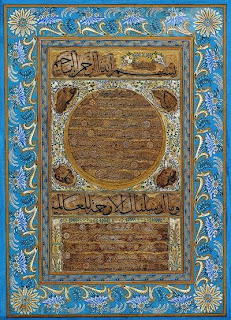
Hilye-i Serif by Hafiz Osman

Image
Combining the calligraphy techniques of sulus and nesih, Hafiz Osman (1642-1698) created one of the finest examples of hilye-i serif . The piece was also inscribed with golden flowers, rococo style. Dimensions: 51x38 cm. Estimated value: $ 60,000

Zerendud Inscription

Image
Zerendud means scribed with gold. Ismail Hakki Altunbezer's (1873 - 1946) framed inscription of cobalt blue is one of my favorites (maybe because of the color). Written with celi sulus technique, it is a fascinating example of Ottoman calligraphy; dated 1922, with a hadith of the prophet Mohammed written on it. Dimensions: 28x44 cm Estimated value: $ 4,500

Weird Creations

Image
Although I am not pleased with the translation, I have decided to literally translate "Acaibü'l Mahlukat", hence the title of the post. The book was written with a calligraphy technique called nesih in 16th century Istanbul. In this book of 176 pages, each of which containing 19 lines, there are 145 miniatures and 9 drawings. Covering the geography and cosmography of the era, it is one of the prime examples of the Islamic literature of the time, a mini encyclopedia or sort of. The book itself was written by Kazvini (died 1283) and translated to Turkish upon the request of Prince Mustafa, the son of Suleiman the Magnificent. Translation effort by Sururi halted for a while when the Prince was killed in 1553, but later was completed by Rodosizade in June 1558. Weird Creations start with a story of a two-headed person and continues with the stars and their movement, known celestial bodies of the time like the Moon, Venus, Mars etc, and goes on telling about the stars of the ...

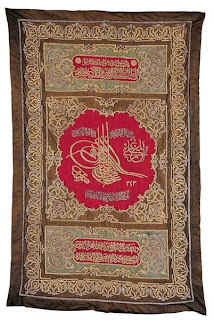
Embroidered Door Curtain

Image
Specially woven for Ottomans in Syria and Egypt, this door curtain of silk was embroidered with gold and silver. The writings belong to Sami Efendi (1838-1912), the renowned hattat (calligrapher) of the period. Dimensions: 250x168 cm. Tagged with a price of $ 90,000, the piece is still not sold.